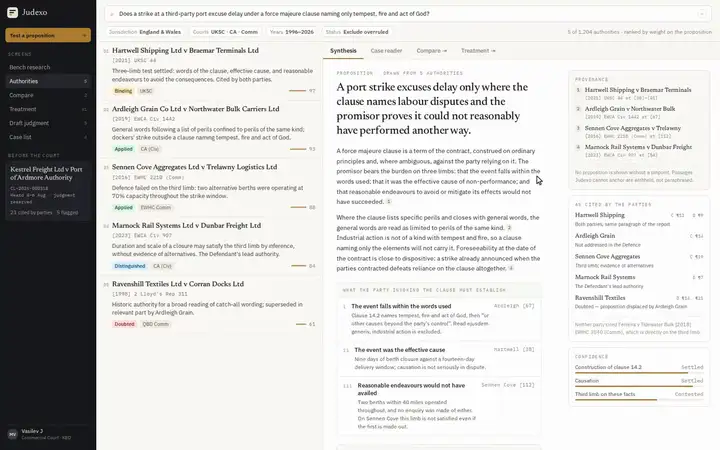
Legal
Precedent finder for litigators
A system that scans a huge corpus of completed court cases and surfaces the precedents that bear on one specific legal issue - in seconds, not billable hours.
We find where AI saves your business time or manual work, determine what should be built, and build it through to production. A vague ambition, a specific opportunity, or a process you already want automated: we pick up where you are.
Production work that used to be commissioned one piece at a time now runs as a pipeline, with review kept in human hands.
A corpus nobody could read end to end became searchable by the actual legal question, with the source passage attached.
Ordinary software where rules are stable. AI where the work is messy language or judgement. A person where being wrong is expensive. Drawing those boundaries is the real design work, and sometimes the answer is a rules engine, not a model.
Fetching, moving, calculating, posting. Anything you could write as a table belongs in a table: cheaper, faster and auditable. Your existing systems keep doing what they are already good at.
Free-text emails, documents in twelve formats, cases nobody wrote a rule for. This is where AI earns its place: input that varies and a decision that is genuinely a decision.
Payments, anything a customer sees, anything the system is not confident about. The threshold needs to be set right: a wrong auto-decision often costs far more than an unnecessary check.

Your contact through the whole project is Malte Poppensieker: he analyses the problem, designs the architecture and manages the build through to production. Your context does not get passed from a consultant to a product manager to an engineer, losing a little meaning at each step.
An SME with a contained operational problem usually needs senior commercial judgement, system definition and hands-on implementation, not a consultancy delivery team funded around it.
Depending on the project, experienced developers from an established network do the implementation and bring specific competencies where the work calls for them - named openly, with overall accountability staying with your contact. Where a programme genuinely needs a standing in-house team, we will say so on the first call.
Systems built for different operational problems: making information usable, producing and reviewing work at scale, removing manual steps, and connecting judgement with action.
A system that scans a huge corpus of completed court cases and surfaces the precedents that bear on one specific legal issue - in seconds, not billable hours.
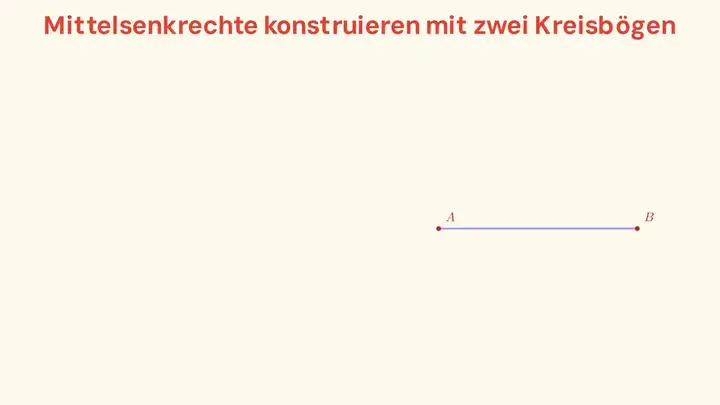
A fully automated pipeline for producing explainer videos end to end. It has been used to create more than 2,400 of them at scale.
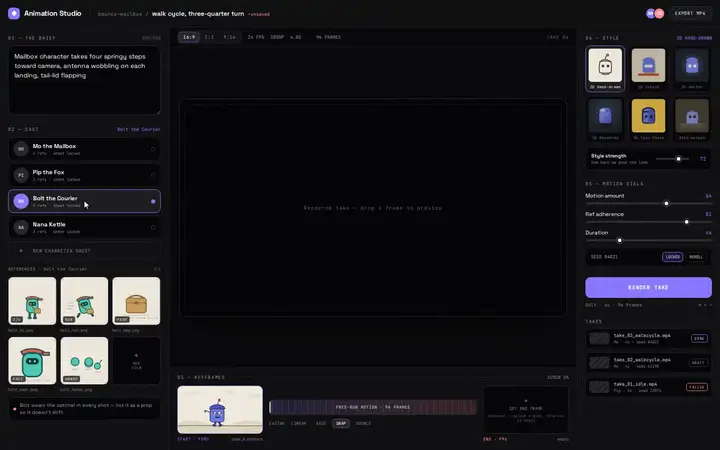
A fully automated character animation process driven by a single prompt - from written intent to finished animated motion with no manual keyframing.
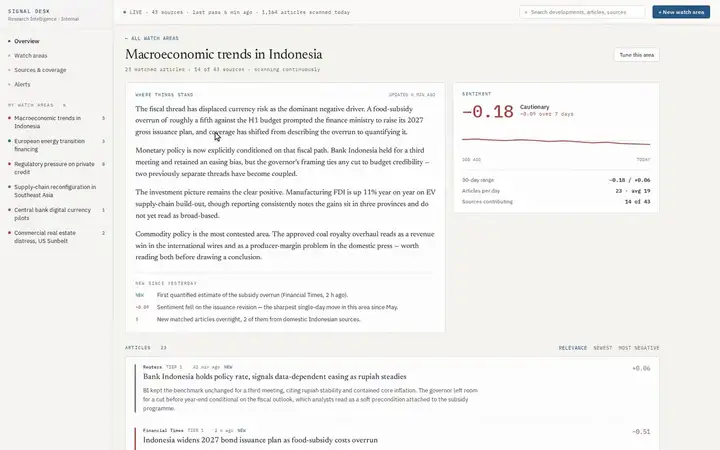
A scanner that processes a large number of news sources continuously and surfaces only the specific content its owner actually cares about.
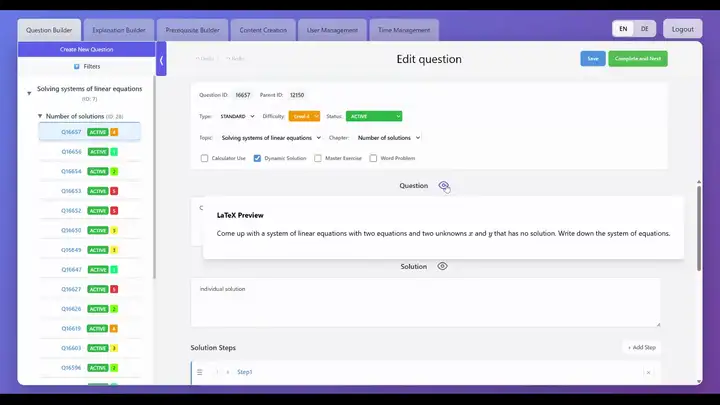
A workflow that pre-generates learning content and routes it through structured human review, so quality stays in human hands while volume stops being the bottleneck.
Four stages. If the earlier ones are already clear in your business, we start further down.
We sit with the people who do the work today and follow it end to end, including the exceptions they handle without thinking about them. What it currently costs in time and error is part of this, not a separate business case exercise.
What is rules, what is AI, where a person approves, and what the system is deliberately not allowed to do. Architecture and how quality gets measured are settled in writing before production code exists.
A working thin slice on representative data: your real documents, your real messages, your awkward cases. If the hard part does not hold up, you find out in week two rather than at the end.
Regular demos during the build, then live inside your tools, on your repository and your keys. For 90 days after go-live, anything that breaks is still our problem.
Most people start in the middle. If the process is already clear in your business, skip ahead — if none of them is, start with a call.
For when you don’t yet know which process to start with. Every candidate found and ranked against the others, the economics compared between them, and an explicit list of the ones to drop.
Send the one workflow you’d most like to stop doing by hand. We’ll analyse it and you get the findings back in writing: what it costs you today, what a first improvement could cover, implementation pricing and a timeline. Or an honest no.
The whole path from a defined system to something running inside your tools: full spec, architecture, the difficult part proven on your real data, then built and deployed.
Bring the vague ambition, the specific opportunity, or the workflow you already want improved.
Thirty minutes on the actual process and where it hurts, and you leave with a sensible next step. If ordinary software or nothing at all is the better answer, we will say that.
Book the free 30-minute conversationThat is the normal case. Systems are built around the tools you already use - accounting system, CRM, mail, file storage - through their APIs, and where there is no API, through the interfaces a person would use. Nothing needs replacing to get started.
Only what a specific request needs goes to a model, and what goes is logged. No training on your data. Processing can run in your own cloud environment, in a specific region, or entirely without external model providers if that is the requirement - decided during scoping rather than discovered in production.
Wherever a mistake is expensive. The system acts on its own where it is confident and the downside is small, and asks a person where it is not, with the evidence attached so the check takes seconds. That threshold is a design decision we make together, not a default.
It depends on the workflow, which is why there is no number on this page. After the first call and a scoping session you get a fixed price for the specific piece of work, and you decide with that in front of you. Running costs are estimated at the same time, so the operating bill is not a surprise.
A contained operational system is usually weeks, not quarters. The difficult part gets proven on your representative data early, and from there you see it running at regular demos - there is no long stretch where you hear nothing.
You do. The repository, the keys and the documented architecture are yours from day one. Nothing here is designed to keep you dependent on us.
We do, for 90 days after go-live, at no extra cost. After that, either an ongoing arrangement or your own team - the documentation is written for someone else to pick it up.
Enterprise-wide transformation programmes, anything needing a permanent in-house team, and general developer capacity. For a defined operational problem inside an existing business, one contact who runs the analysis, the architecture and the build is usually faster than a large team that has to coordinate. Where a project grows or needs a specific skill, developers from an established network join for exactly that part.